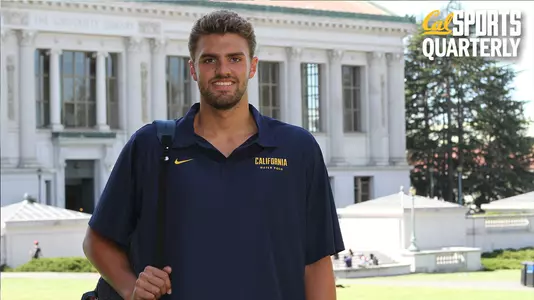
Men's Water Polo's Tim Simenc made a documentary about the student-athlete experience at Cal.
Photo by: Cal Athletics
10/5/2016 10:53 AM | Men's Water Polo, Inside The Lair
This feature originally appeared in the Fall edition of the Cal Sports Quarterly. The Cal Athletics flagship magazine features long-form sports journalism at its finest and provides in-depth coverage of the scholar-athlete experience in Berkeley. Printed copies are mailed four times a year to Bear Backers who give annually at the Bear Club level (currently $600 or more). For more information on how you can receive a printed version of the Cal Sports Quarterly at home, send an email to calbearbackers@berkeley.edu or call (510) 642-2427.
Standing on the steps of Sproul Hall, the buzz of a weekday morning in the fall is unmistakable. Students hustling to class grip coffee in one hand, cell phone in the other and the challenge of settling into the back row of a lecture hall seconds before the doors shut seems more like rush hour in Manhattan than the laid-back crawl of West Coast life.
Now, stand in that same spot and watch the scene play out with a different focus.
Is it easy to identify a Cal student-athlete as he or she makes that journey? How would you know what to look for? What would make a Division I athlete stand out among a sea of the most accomplished college students in the world?
Tim Simenc (pronounced Simmons) knows that trek. As a sophomore on the Cal men's water polo team, he could cross Sproul Plaza clad in blue and gold sweats and there wouldn't be any mistaking his purpose in Berkeley. He is a Division I student-athlete at a school that owns more national titles in his sport than any other institution in the country. He is here to win, and it would be easy to assume that an hour and a half spent in the last row of a 700-seat room is simply a means to that end.
Simenc knows that stereotype because he has heard it before.
This summer, the native of Dallas, Texas, set out to explore those commonly held notions in a slightly more in-depth fashion. An intended film and business major, Simenc began work on a documentary that chronicles the most widely held misconceptions of college student-athletes. The project didn't come from a class or team assignment. Instead, he tackled the issue with a vision all his own, seeking to find out what people really think of student-athletes.
"The whole thing started with my parents talking about what I was going to do over the summer," Simenc said. "They wanted me to get an internship or do summer school and I said no, I kind of want to do a documentary. I had done a documentary before I came to Cal with my high school and I really enjoyed it. I also thought this was a very specific idea for athletes and something that we really struggle with, I feel, day to day."
So, he started work on an issue that had crept to the forefront of his mind over time spent attending classes at Cal. He contacted student-athletes, athletic department administrators and friends to set up interviews with a specific set of questions in mind.
Those were focus groups he could control. He also needed voices not tied to the topic, and for that he turned to a tried and true method of gathering information.
He stood on Sproul Plaza and asked questions.
"When I started going through the project, there are some nasty things I saw online written about student-athletes," Simenc said. "But when I went out on Sproul and actually interviewed students, the biggest grievances they had were that athletes were always kind of in the spotlight and the rest of the students weren't. They're doing incredible things as well but not getting the same attention as athletes."
The questions didn't stop on Sproul. Simenc sat down with members of both the Cal men's and women's water polo teams as well as rugby and, as the semester started, he had more planned as student-athletes returned to Berkeley to begin classes.
That led him to Emily Loughlin, a center on the women's water polo team who has also has some experience with significant issues around student-athlete welfare. She teaches a DeCal class titled "Female Student-Athlete Leadership" that offers a forum to discuss topics and ideas that revolve around the experience of female student-athletes at Cal.
Predictably, she had a particularly pragmatic answer for Simenc's questions.
"Some of the most commonly held stereotypes of student-athletes are that student-athletes are just here to play sports and they could care less about their classes or education. This could not be farther from the truth," Loughlin said. "My coaches and teammates take great pride in our team GPA and individual academic success. We all push each other to succeed in both the classroom and the pool. The belief in this stereotype is hurtful; sometimes in group projects, students will distribute me less of the work because of this. Conversely, I have also come across students who truly respect the fact I am a student-athlete and are really supportive of what we do, (waking up at 6 a.m. and coming to class) they'll even express and interest and come to our games."
Simenc didn't stop there. He interviewed Haas School of Business professor Steve Etter as well as Cal's director of student-athlete affairs, Paul Savage, in an attempt to understand how these issues are viewed by those who see students cycle in and out every four years.
"I prepared Tim that he might find not only glaring evidence of how student-athletes at Cal exceed the stereotypes of a college athlete," Savage said, "but that as a result he might uncover more unique accomplishments than he could feature."
Making a documentary on his own time is only one piece of Simenc's pursuit of the total student-athlete experience. During his freshman season, he joined the GiANT film-making club, and even though he admits it didn't go quite as well as he'd hoped, it sparked the creative impetus that led to his summer pursuit. He continued to assimilate into college life while at the same time spending much of his time at Spieker Aquatics Complex.
He also joined the Golden Bear Advisory Committee (GBAC) to participate in decision-making about events and activities as well as provide input on NCAA rules and regulations alongside other student-athletes. In April, he visited the Pac-12 Conference offices with track & field's Destiny Parker to represent Cal at the semi-annual Student-Athlete Advisory Committee meetings.
"Tim's posture is one of extreme gratitude for access to the student-athlete experience," Savage said. "He is passionate about giving back to his peers to improve their sense of community and support. He smartly understands that it was important to start with their individual stories and perspectives so he is in a position to better serve in his leadership role. Using his summer to do this while building his documentary portfolio is both enterprising and indicative of his commitment to his elected position."
Simenc recently finished the documentary, and he plans to submit it to film festivals and distribute using grassroots methods like social media to spread the word. And it may only be one step in a lifelong creative process for the sophomore, who has plenty of time to add to his college experience both in the pool and on dry land.



Monday, August 29
Saturday, August 13
Thursday, May 08
Wednesday, April 30