California Golden Bears Athletics
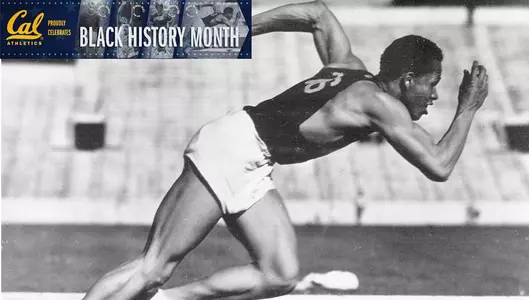
Flying High: Archie Williams Made Impact At Cal
2/11/2015 12:00 AM | Inside The Lair, Olympics
Cal Athletics celebrates Black History Month with a series of features that recognize the accomplishments of our African-American student-athletes, coaches and staff.
Williams, who grew up in the shadow of the Campanile off of Telegraph Ave., had always wanted to attend Cal – but not because he could run fast. Williams was fascinated by aeronautics and engineering, and wanted to get an education.
So it didn't bother him that he wasn't recruited by any colleges in high school or junior college.
“No one approached me and I didn't care because I was going to play in the physics lab,” Williams said in an oral history by the Cal Regional Oral History Office published in 1992.
Turns out Williams ended up expanding his playing field. In addition to earning his degree in mechanical engineering from Cal and having an accomplished career in the Air Force and as a teacher, Williams ended up being a generational athlete. After attending San Mateo JC for one year, he transferred to Cal and tried out for the Bears' track & field team. Legendary coach Brutus Hamilton immediately recognized his extraordinary athletic talents, and Williams went on to set a world record in the 400 meters at the 1936 NCAA Championships in Chicago.
A few months later, Williams won the Gold Medal in the 400 at the 1936 Summer Olympics in Berlin, Germany.
“It was like a dream,” Williams said in the oral history. “You were dreaming you were in something that you thought about before. Did I really do that? I think most people feel that same way, especially me because one year I was nothing, the next year I was this.”
Williams returned to the Bay Area after the Olympics and was honored with a parade to City Hall in Oakland, where he was given a key to the city. He rode in a fire engine and there was a rally to celebrate his achievements on the steps of Wheeler Hall on campus.
That's when Williams started focusing on the non-athletic part of his persona. The next year, he became the first African-American student at Cal to run for student council. He lost by a narrow margin.
As a senior, he was the only African-American to take part in the Civilian Pilot Training Program, which was designed to develop potential pilots for war. Despite being an accomplished student, his desire to fly airplanes was squashed by discrimination and he wound up as a “grease monkey,” a term given to those who work on airplanes, at the Oakland Airport.
Williams eventually earned his instructor's license and taught civilians at the Tuskegee Institute in Alabama. First Lady Eleanor Roosevelt visited the airfield and worked to turn it into a military school for flying. Williams ended up training fighter pilots for combat.
“They started recruiting the black instructors,” Williams said in the oral history. “These guys were real good. The only place we could get jobs as black instructors was Tuskegee.”
After working in Tuskegee for a few years, Williams went to UCLA to learn meteorology and went back to Tuskegee to be a weather officer. He also resumed instructing pilots how to fly.
That launched a long career in the Air Force. Williams ultimately attended the Air Force Institute of Technology and became a weather forecaster for all of the air defense on the East Coast.
After 22 years Williams retired from the Air Force in 1964. His experience as a flight instructor had given him a passion for teaching, so he earned his teaching credential from UC Riverside and got a job as a math and computer science teacher at Sir Francis Drake High School in San Anselmo.
“I started thinking about what I could do,” Williams said in the oral history. “I enjoy teaching. I just needed to learn how to run a slide projector.”
Williams taught at Sir Francis Drake for 21 years before he retired at the age of 72. He died six years later.
Williams was inducted into the Cal Athletic Hall of Fame in 1986, receiving an honor from the school he always had his eyes on every time he walked out his front door as a child.
“I saw that Campanile and I wanted to go to that school,” Williams said in the oral history. “I made it and got my degree.”
And a whole lot more.