California Golden Bears Athletics
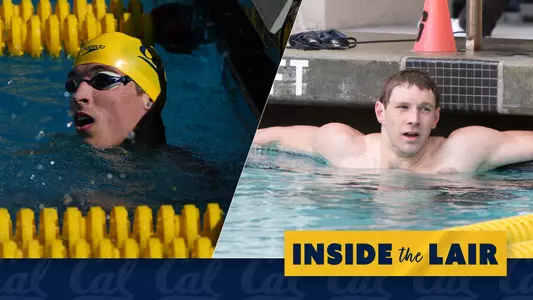
Olympic gold medalist Ryan Murphy and All-American Bjorn Seeliger discuss the balance of competing for a national title in an Olympic year.
Paris On The Mind
3/26/2024 2:21 PM | Inside The Lair, Men's Swimming & Diving
Golden Bears Balance NCAA Title Quest, Olympic Dreams
Fewer turns and longer swims.
There are two subtle differences between short-course and long-course racing, and every four years, California Director of Swimming & Diving David Durden has to balance preparing his athletes for short-course competition at the NCAA Championships while keeping an eye on the long-course format of the Olympics, held this summer in Paris.
"The way Dave approaches the balance between the Olympics and NCAAs is a testament to his leadership," four-time Olympic gold medalist and 12-time NCAA champion Ryan Murphy said. "He sets aside some personal gain – like winning a Pac-12 title – and instead focuses on his athletes' personal goals."
Months ahead of the 2016 Summer Olympics in Rio de Janeiro, Brazil, Durden and his staff sent a group of Golden Bears – including Murphy, Josh Prenot and Jacob Pebley, among others – to Orlando to swim in a long-course competition instead of joining their Cal teammates at the Pac-12 Championships in Federal Way, Washington. That summer, the trio of Murphy, Prenot and Pebley qualified for the U.S. Olympic team, culminating in Murphy winning three gold medals – he swept the backstroke events and swam on the 4x100-meter medley – and Prenot taking silver in the 200-meter breaststroke.
Earlier this month, Cal elected to send five of its top-scoring athletes to a long-course meet instead of Pac-12s to better prepare them for the upcoming Olympic Trials and Olympic Games.
"The way Cal typically approached Pac-12s was to use it as a meet for swimmers to earn NCAA qualifying times, if they hadn't already done so, so us not being there (in 2016) wasn't that strange," said Murphy, who had already achieved the necessary NCAA qualifying times when Pac-12s came around. "We didn't want to eliminate the excitement of the NCAAs – we wanted to capitalize on that – but we also needed to keep a detailed focus on long course. And that's a very subtle approach."
Durden's ability to help the Golden Bears capitalize on their short-term goals at the NCAAs and long-term goals at the Olympics makes all the difference in an Olympic year, when an added level of attention is present.
"Dave would have us do an extra long-course practice each week throughout the fall and into the spring – he always made sure we got those long-course reps," Murphy said. "As we got closer to NCAAs, we shifted focus to short-course, but there was always an underlying level of attention on long course that Dave did so well with."
Current Cal senior Björn Seeliger has noticed that same attention to detail this year.
"Dave is adamant about not letting the athletes too much into his plan," said Seeliger, who competed for Sweden at the last Summer Olympics in Tokyo. "He is really good about getting us to show up to practice and work hard, but he doesn't want us to worry about the process."
To the uninitiated, the difference between long-course and short-course swimming seems minimal. But in a sport where winning is decided by tenths of seconds, subtle differences are everything. Short-course events are swum in a 25-meter or 25-yard pool, resulting in twice the number of turns compared to long-course events, which use a 50-meter pool. Training for short-course racing focuses more on the approach to the walls, whereas stroke technique on top of the water is emphasized in long-course swimming.
"One of the main differences (with short-course swimming) is the velocity you have (diving) off the block or coming off a wall," Seeliger said. "You have more opportunities to regain speed at the NCAA level. In (long course), it's an emphasis on more swimming than turning and pushing; Dave wants us to feel comfortable in a longer pool and not lose that familiarity, all while preparing for NCAAs."
Roughly less than three months separate this week's NCAA Championships and the U.S. Olympic team trials in June, but Durden's calculated plan for each athlete allows for a balance of short-course and long-course training.
Seeliger has already qualified for Sweden's Olympic team. He and Cal's other Olympic hopefuls – Jack Alexy, Gabriel Jett, Destin Lasco, Dare Rose and more – trained long course at the U.S. Olympic Training Center in Colorado Springs, Colorado, at the turn of the new year. The time spent at the OTC, though short, gave the Golden Bears an opportunity to focus on long course during a gap in the collegiate season.
Murphy reflected fondly on Durden's style allowing for Cal swimmers to enjoy – and excel – at both the NCAAs and the Olympics.
"I think the NCAAs is the best meet there is," Murphy said. "You're living and competing with your teammates and that's a very different dynamic than the Olympics, where individual goals become your focus. Everyone was fired up for it to be an Olympic year (in 2016). Some guys pushed that motivation toward success at the NCAAs, others focused more on long course."
The Golden Bears will look to win their third straight NCAA title this week at the IU Natatorium in Indianapolis. After that, more long-course work lies ahead..
"The separation between the NCAAs and the Olympics is important," Seeliger said. "Right now, I'm focused on short-course yards and an NCAA title. But once Sunday (after NCAAs) comes around and we are fully done, we're going to transition right back into long-course mode. And since we've emphasized that all year, it never really leaves your mind."
STAY POSTED
For complete coverage of Cal swimming and diving, please follow the Bears on Twitter (@CalMenSwim, @CalWSwim), Instagram (@CalMenSwim, @calwswim) and Facebook (Facebook.com/CalMensSwimmingandDiving, Facebook.com/CalWomensSwimmingandDiving).
There are two subtle differences between short-course and long-course racing, and every four years, California Director of Swimming & Diving David Durden has to balance preparing his athletes for short-course competition at the NCAA Championships while keeping an eye on the long-course format of the Olympics, held this summer in Paris.
"The way Dave approaches the balance between the Olympics and NCAAs is a testament to his leadership," four-time Olympic gold medalist and 12-time NCAA champion Ryan Murphy said. "He sets aside some personal gain – like winning a Pac-12 title – and instead focuses on his athletes' personal goals."
Months ahead of the 2016 Summer Olympics in Rio de Janeiro, Brazil, Durden and his staff sent a group of Golden Bears – including Murphy, Josh Prenot and Jacob Pebley, among others – to Orlando to swim in a long-course competition instead of joining their Cal teammates at the Pac-12 Championships in Federal Way, Washington. That summer, the trio of Murphy, Prenot and Pebley qualified for the U.S. Olympic team, culminating in Murphy winning three gold medals – he swept the backstroke events and swam on the 4x100-meter medley – and Prenot taking silver in the 200-meter breaststroke.
Earlier this month, Cal elected to send five of its top-scoring athletes to a long-course meet instead of Pac-12s to better prepare them for the upcoming Olympic Trials and Olympic Games.
"The way Cal typically approached Pac-12s was to use it as a meet for swimmers to earn NCAA qualifying times, if they hadn't already done so, so us not being there (in 2016) wasn't that strange," said Murphy, who had already achieved the necessary NCAA qualifying times when Pac-12s came around. "We didn't want to eliminate the excitement of the NCAAs – we wanted to capitalize on that – but we also needed to keep a detailed focus on long course. And that's a very subtle approach."
Durden's ability to help the Golden Bears capitalize on their short-term goals at the NCAAs and long-term goals at the Olympics makes all the difference in an Olympic year, when an added level of attention is present.
"Dave would have us do an extra long-course practice each week throughout the fall and into the spring – he always made sure we got those long-course reps," Murphy said. "As we got closer to NCAAs, we shifted focus to short-course, but there was always an underlying level of attention on long course that Dave did so well with."
Current Cal senior Björn Seeliger has noticed that same attention to detail this year.
"Dave is adamant about not letting the athletes too much into his plan," said Seeliger, who competed for Sweden at the last Summer Olympics in Tokyo. "He is really good about getting us to show up to practice and work hard, but he doesn't want us to worry about the process."
To the uninitiated, the difference between long-course and short-course swimming seems minimal. But in a sport where winning is decided by tenths of seconds, subtle differences are everything. Short-course events are swum in a 25-meter or 25-yard pool, resulting in twice the number of turns compared to long-course events, which use a 50-meter pool. Training for short-course racing focuses more on the approach to the walls, whereas stroke technique on top of the water is emphasized in long-course swimming.
"One of the main differences (with short-course swimming) is the velocity you have (diving) off the block or coming off a wall," Seeliger said. "You have more opportunities to regain speed at the NCAA level. In (long course), it's an emphasis on more swimming than turning and pushing; Dave wants us to feel comfortable in a longer pool and not lose that familiarity, all while preparing for NCAAs."
Roughly less than three months separate this week's NCAA Championships and the U.S. Olympic team trials in June, but Durden's calculated plan for each athlete allows for a balance of short-course and long-course training.
Seeliger has already qualified for Sweden's Olympic team. He and Cal's other Olympic hopefuls – Jack Alexy, Gabriel Jett, Destin Lasco, Dare Rose and more – trained long course at the U.S. Olympic Training Center in Colorado Springs, Colorado, at the turn of the new year. The time spent at the OTC, though short, gave the Golden Bears an opportunity to focus on long course during a gap in the collegiate season.
Murphy reflected fondly on Durden's style allowing for Cal swimmers to enjoy – and excel – at both the NCAAs and the Olympics.
"I think the NCAAs is the best meet there is," Murphy said. "You're living and competing with your teammates and that's a very different dynamic than the Olympics, where individual goals become your focus. Everyone was fired up for it to be an Olympic year (in 2016). Some guys pushed that motivation toward success at the NCAAs, others focused more on long course."
The Golden Bears will look to win their third straight NCAA title this week at the IU Natatorium in Indianapolis. After that, more long-course work lies ahead..
"The separation between the NCAAs and the Olympics is important," Seeliger said. "Right now, I'm focused on short-course yards and an NCAA title. But once Sunday (after NCAAs) comes around and we are fully done, we're going to transition right back into long-course mode. And since we've emphasized that all year, it never really leaves your mind."
STAY POSTED
For complete coverage of Cal swimming and diving, please follow the Bears on Twitter (@CalMenSwim, @CalWSwim), Instagram (@CalMenSwim, @calwswim) and Facebook (Facebook.com/CalMensSwimmingandDiving, Facebook.com/CalWomensSwimmingandDiving).

Players Mentioned

Free/Back
/ Men's Swimming & Diving
Free/Back/Fly
/ Men's Swimming & Diving
Free/IM/Back
/ Men's Swimming & Diving
Free/Fly
/ Men's Swimming & DivingMonday, March 27
Monday, March 27
Monday, March 06
Monday, March 06