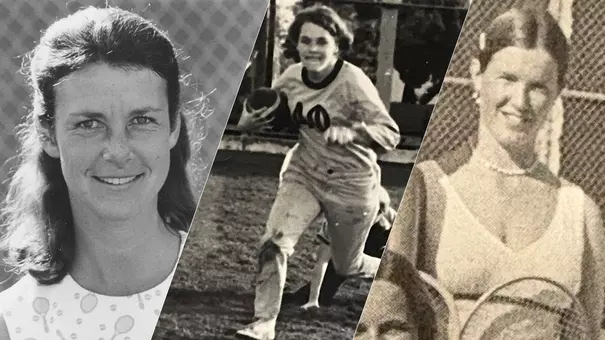
Head Coaching Role Now Called The Stacy Savides Director Of Women’s Tennis
By: Anna Maria Lima
For Cal women's tennis alum Stacy Savides '85, the lessons that shaped her career and leadership style began long before Google. They were built on the courts at Cal — through demanding practices, honest conversations, deep team camaraderie, and a coach who challenged her players to grow both mentally and physically.
Now, nearly four decades after graduating, Savides is investing in the future of the program that helped shape her life. Through a transformative $3 million gift, she is endowing the women's tennis head coach position, which will now be known as The Stacy Savides Director of Women's Tennis - ensuring future generations of student-athletes benefit from exceptional leadership and enduring support.
Savides currently serves as Vice President of People Operations and Chief Culture Officer at Google, where she has spent nearly 26 years helping build one of the most influential workplace cultures in the world. But before her career in Silicon Valley, the foundation for that work was being laid at Cal.
Raised in a Northern California tennis family, Savides grew up on the courts. Her parents played regularly, and soon enough, Stacy and her siblings quickly became nationally ranked junior players. All three siblings would eventually compete collegiately — her older brother at Harvard, her younger sister at Stanford, and Stacy at Berkeley.
Though she had opportunities at several universities, Cal always held special significance. Her father frequently told her that if she worked hard and earned strong grades, Berkeley would open extraordinary doors for her. As Savides would later discover, he was right.
"It helped shape so much of who I am as a leader and contributor," Savides said, "especially in a large company where you work with so many different people and constantly changing business needs — it's incredibly dynamic."
She credits much of that growth to her coach at Cal, the legendary Jan Brogan.
Decades before mental performance coaching became mainstream in athletics, Brogan emphasized the psychological side of training. Through meditation, visualization techniques, and direct peer accountability, she encouraged her players to confront fear, navigate adversity, and communicate directly with one another — all in pursuit of collective growth. Combined with rigorous practices twice a day and often on weekends, Brogan and her staff developed far more than successful tennis players. They cultivated individuals with resilience, discipline, and self-awareness. Stacy Savides with coaches Jan Brogan and Peter Wright.
"My coaching philosophy from early on was to create a team environment in the sport of tennis," Brogan said. "Having teammates to push and encourage one another to achieve what each might have thought impossible if left on their own is an amazing experience. Stacy was such a fierce competitor, excellent teammate, and exceptional student. I will forever be grateful for her support of the women's tennis program."
"I learned to be resilient and focused heavily on building strong, constructive relationships with diverse team members," Savides said. "We figured out how to come together as one team and to prioritize clear communication and a culture of mutual support. The coaching experience from Jan really led the way for me."
Those lessons extended well beyond the court. Savides and her teammates studied together, advocated for each other, and figured out how to balance academics, athletics, and their social lives as a group.
"We embraced the full opportunity at such a spirited university," she said. "There was real joy in being part of something bigger than any one player or any one match."
Today, those bonds are very much alive. Savides, her former teammates, and Brogan still maintain the community they built together at Cal. With many of them living across the Bay and the Peninsula, they share texts, get together, watch tennis, and still find time to compete and practice alongside each other.
That sense of connection is central to why Savides gives back.
"We've managed to really keep that special connection and community, which has been wonderful and contributes a lot to why I want to give back," she said. "The broader tennis community at Cal has been growing and is something that I want to really help contribute toward and invest in."
Her love for Berkeley has also extended through generations of her family. Savides proudly shared Cal with her sons and nephews, all of whom attended the university and embraced their own full Berkeley experiences.
"Cal has really been the cornerstone of my personal and professional growth — starting by shaping my actual discipline and resilience as a student-athlete and then later grounding my perspectives, even as a parent," she said. "And now, the opportunity to give back is compelling for me."
That belief in community, leadership, and long-term impact ultimately inspired her latest gift.
Though she initially hesitated to attach her name to the role, conversations with her family helped her see the broader significance of the gesture.
"It'd be humbling to have my name associated with the program's future," Savides said. "For me, it's less about recognition and more about ensuring the women's tennis program has the resources to thrive long term. I really hope this endowment allows our student-athletes to excel on the court and in life, and that it can build a lasting legacy."
"We are so grateful to Stacy for her decision to endow and name this head coaching position," Cal Co-Director of Athletics Jenny Simon-O'Neill said. "This means a lot for the department, but also specifically for our female student-athletes seeing one of their own turn around and give back in this really massive way."
For Savides, investing in leadership is one of the most meaningful ways to shape the future of the program she loves.
"An outstanding coach is critical — one who can truly elevate the performance of the team and the entire program," she said. I want to do my part in helping bring the program to the level it needs to be. It all starts at the top, so having an incredible leader is essential."