California Golden Bears Athletics
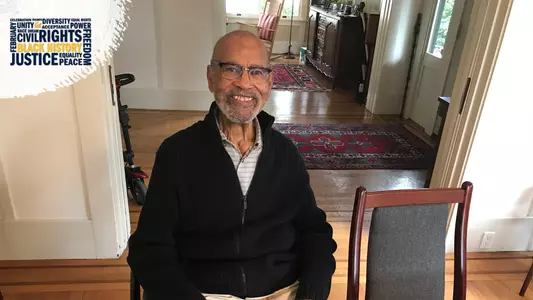
Thelton Henderson played football and baseball at Cal before embarking on a transformative career as an attorney and judge.
Photo by: Cal Athletics
Judgment Call
2/6/2019 9:59 AM | Baseball, Football, Inside The Lair
Thelton Henderson Left The Football Field For The Courthouse
Note: Cal Athletics celebrates Black History Month with a series of features throughout the month of February.
BERKELEY – Thelton Henderson was a pioneer for African-American attorneys, a transformative lawyer who worked in the same circles as Martin Luther King Jr. during the Civil Rights Movement.
And he owes it all to a torn-up knee he suffered at California Memorial Stadium.
Henderson played for the Golden Bear football team during the early 1950s, a speedy halfback-turned-safety from South Central Los Angeles. But midway through the 1952 season, he tore his ACL on the kick coverage team during a game against Santa Clara, effectively ending his football career.
Henderson decided to try his luck playing for legendary coach Clint Evans on the Cal baseball team, and although he impressed during his one season on the diamond, he was even more accomplished in the classroom.
Without the demands of football, Henderson sunk his teeth into his studies. That set the course for an accomplished career in law, one that is still going at the age of 85 as a visiting professor at Berkeley Law.
"Without football, I became a serious student," Henderson said recently during an interview at his Berkeley home. "I really credit that with my career in the sense that I really had time to study and I had the motivation to get the kind of grades that you need to get into a top-tier law school. I now describe it as the best thing that ever happened to me."
Henderson wasn't necessarily ready to embrace the academic demands of UC Berkeley when he arrived on campus during the summer of 1951 from Jefferson High School in Los Angeles. He needed to take classes in Geology and History that summer to become eligible, and his thoughts were more on football than any classroom accomplishments.
He tried to return to the gridiron after his ACL injury, but it was apparent he wouldn't be able to recapture the speed he possessed before the injury. Legendary coach Pappy Waldorf told Henderson, "There's a place in football for a big, slow player and there's a place in football for a little, fast player. But there is just no place in football for a little, slow player."
"I got the message," Henderson said.
Faculty at the Boalt Law School (since renamed Berkeley Law) made a habit of taking in Cal baseball games during those days, and during Henderson's one year on the team he became friendly with Adrian Kragen, an esteemed professor in tax law. Henderson was later accepted into the law school.
"I went to Boalt and wanted to be a tax lawyer – until I took his course," Henderson said.
Henderson ended up being just one of two African-American students in the graduating class at Boalt in 1962. Shortly before his graduation, he received a note from the dean of the law school at the time, William Prosser, to meet him in his office.
Berkeley Law alum John Doar, who at the time was the Deputy Assistant Attorney General for Civil Rights under President John F. Kennedy, was looking to diversify the U.S. Justice Department and had contacted Prosser about any up-and-coming African-American law students. Doar ended up hiring Henderson as the first African-American field attorney for the Civil Rights Division of the U.S. Department of Justice.
That was the beginning of a long, distinguished and impactful career as both a lawyer and judge. Henderson's first assignment was to move to the South to monitor civil rights abuses and protect voter rights. That found him often in the same space as Dr. King, and the two forged a strong relationship – as it turned out, a little too strong for his job security.
Henderson and King were both staying at the A.G. Gaston Motel in Birmingham, Ala. one day in 1963. As Henderson was pulling into the parking lot after spending the day working on a voting rights case, King was pulling out to make the near 90-mile drive to Selma to preach. They rolled down their windows to talk, and King eventually asked if he could borrow Henderson's car since one of his tires was low on air.
"The ride there was through some pretty rough Ku Klux Klan country," Henderson said. "It wouldn't have been a good place to break down. I would have loaned the car anyway. Without thinking about it further than that, I said sure."
As was commonplace during that time, King was being followed. Representatives for Alabama Gov. George Wallace traced the license plate as a rental car registered to Henderson, and the Kennedy administration was accused of intentionally having Justice Department attorneys working in conjunction with King and the Civil Rights Movement.
Henderson was described as a "high-ranking" U.S. government official, and was promptly fired.
"I wasn't even in the car," Henderson said. "The newspapers said I was driving King around."
Henderson eventually moved back to the Bay Area and went into private practice as well as teaching at Stanford and Golden Gate University. In 1980, President Jimmy Carter appointed him to the United States District Court and he became chief judge for the Northern District of California. While serving on the bench, Henderson was involved with notable cases involving affirmative action, prison reform, police brutality and the treatment of dolphins within the fishing industry.
Henderson served on the bench for nearly four decades before retiring in 2017. He still co-teaches a course at Berkeley Law and serves as a visiting lecturer for other classes while meeting with students and conducting research as well.
"Mr. Henderson was a guest speaker in my Civil Procedure class last fall. It was one of the most inspiring hours of my life," said current Berkeley Law student and former Cal volleyball player Maddy Kerr. "To be in the same room as such a trailblazer was surreal. Mr. Henderson's legacy has had a big impact on the Berkeley Law community, which places great emphasis on pro bono work and social justice, and that legacy makes me proud to be a student here."
Henderson has been the recipient of numerous awards and honors, including the American Bar Association's Thurgood Marshall Award, the State Bar of California's Bernard E. Witkin Medal and the Distinguished Service Award from the National Bar Association. Berkeley Law established the Thelton E. Henderson Center for Social Justice in his name and in 2005 a documentary about his life, Soul of Justice, was released.
"For a long time, I just sort of didn't know what all the shouting was about," Henderson said. "I didn't think I did anything special. I think I did what should be done. You find prisoners dying in jail from want of medical care, or your find dolphins being slaughtered, of course you do something about it. I didn't think it was anything special. I was doing what I thought was right."
BERKELEY – Thelton Henderson was a pioneer for African-American attorneys, a transformative lawyer who worked in the same circles as Martin Luther King Jr. during the Civil Rights Movement.
And he owes it all to a torn-up knee he suffered at California Memorial Stadium.
Henderson played for the Golden Bear football team during the early 1950s, a speedy halfback-turned-safety from South Central Los Angeles. But midway through the 1952 season, he tore his ACL on the kick coverage team during a game against Santa Clara, effectively ending his football career.
Henderson decided to try his luck playing for legendary coach Clint Evans on the Cal baseball team, and although he impressed during his one season on the diamond, he was even more accomplished in the classroom.
Without the demands of football, Henderson sunk his teeth into his studies. That set the course for an accomplished career in law, one that is still going at the age of 85 as a visiting professor at Berkeley Law.
"Without football, I became a serious student," Henderson said recently during an interview at his Berkeley home. "I really credit that with my career in the sense that I really had time to study and I had the motivation to get the kind of grades that you need to get into a top-tier law school. I now describe it as the best thing that ever happened to me."
Henderson wasn't necessarily ready to embrace the academic demands of UC Berkeley when he arrived on campus during the summer of 1951 from Jefferson High School in Los Angeles. He needed to take classes in Geology and History that summer to become eligible, and his thoughts were more on football than any classroom accomplishments.
He tried to return to the gridiron after his ACL injury, but it was apparent he wouldn't be able to recapture the speed he possessed before the injury. Legendary coach Pappy Waldorf told Henderson, "There's a place in football for a big, slow player and there's a place in football for a little, fast player. But there is just no place in football for a little, slow player."
"I got the message," Henderson said.
Faculty at the Boalt Law School (since renamed Berkeley Law) made a habit of taking in Cal baseball games during those days, and during Henderson's one year on the team he became friendly with Adrian Kragen, an esteemed professor in tax law. Henderson was later accepted into the law school.
"I went to Boalt and wanted to be a tax lawyer – until I took his course," Henderson said.
Henderson ended up being just one of two African-American students in the graduating class at Boalt in 1962. Shortly before his graduation, he received a note from the dean of the law school at the time, William Prosser, to meet him in his office.
Berkeley Law alum John Doar, who at the time was the Deputy Assistant Attorney General for Civil Rights under President John F. Kennedy, was looking to diversify the U.S. Justice Department and had contacted Prosser about any up-and-coming African-American law students. Doar ended up hiring Henderson as the first African-American field attorney for the Civil Rights Division of the U.S. Department of Justice.
That was the beginning of a long, distinguished and impactful career as both a lawyer and judge. Henderson's first assignment was to move to the South to monitor civil rights abuses and protect voter rights. That found him often in the same space as Dr. King, and the two forged a strong relationship – as it turned out, a little too strong for his job security.
Henderson and King were both staying at the A.G. Gaston Motel in Birmingham, Ala. one day in 1963. As Henderson was pulling into the parking lot after spending the day working on a voting rights case, King was pulling out to make the near 90-mile drive to Selma to preach. They rolled down their windows to talk, and King eventually asked if he could borrow Henderson's car since one of his tires was low on air.
"The ride there was through some pretty rough Ku Klux Klan country," Henderson said. "It wouldn't have been a good place to break down. I would have loaned the car anyway. Without thinking about it further than that, I said sure."
As was commonplace during that time, King was being followed. Representatives for Alabama Gov. George Wallace traced the license plate as a rental car registered to Henderson, and the Kennedy administration was accused of intentionally having Justice Department attorneys working in conjunction with King and the Civil Rights Movement.
Henderson was described as a "high-ranking" U.S. government official, and was promptly fired.
"I wasn't even in the car," Henderson said. "The newspapers said I was driving King around."
Henderson eventually moved back to the Bay Area and went into private practice as well as teaching at Stanford and Golden Gate University. In 1980, President Jimmy Carter appointed him to the United States District Court and he became chief judge for the Northern District of California. While serving on the bench, Henderson was involved with notable cases involving affirmative action, prison reform, police brutality and the treatment of dolphins within the fishing industry.
Henderson served on the bench for nearly four decades before retiring in 2017. He still co-teaches a course at Berkeley Law and serves as a visiting lecturer for other classes while meeting with students and conducting research as well.
"Mr. Henderson was a guest speaker in my Civil Procedure class last fall. It was one of the most inspiring hours of my life," said current Berkeley Law student and former Cal volleyball player Maddy Kerr. "To be in the same room as such a trailblazer was surreal. Mr. Henderson's legacy has had a big impact on the Berkeley Law community, which places great emphasis on pro bono work and social justice, and that legacy makes me proud to be a student here."
Henderson has been the recipient of numerous awards and honors, including the American Bar Association's Thurgood Marshall Award, the State Bar of California's Bernard E. Witkin Medal and the Distinguished Service Award from the National Bar Association. Berkeley Law established the Thelton E. Henderson Center for Social Justice in his name and in 2005 a documentary about his life, Soul of Justice, was released.
"For a long time, I just sort of didn't know what all the shouting was about," Henderson said. "I didn't think I did anything special. I think I did what should be done. You find prisoners dying in jail from want of medical care, or your find dolphins being slaughtered, of course you do something about it. I didn't think it was anything special. I was doing what I thought was right."

Monday, August 29
Saturday, August 13
Thursday, May 08
Wednesday, April 30